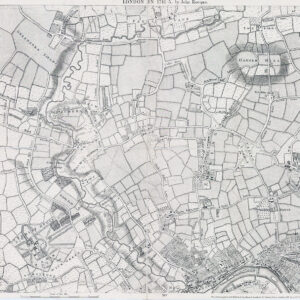
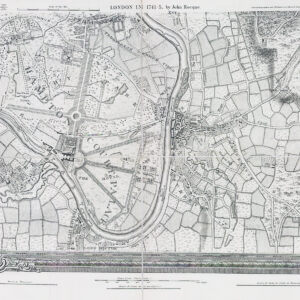
1831 "LAURIE'S New Plan of LONDON and its ENVIRONS, Comprising the NEW BUILDINGS and RECENT IMPROVEMENTS Being an Original Survey by JOHN OUTHETT. 1831".
A very fine map, dissected into 24 sections and laid onto new linen. The map extends west to east from Hyde Park to Greenwich and north to south from Hampstead to Camberwell. Limits of the City of London, Westminster, Southwark, and Rules of the Kings Bench, Fleet Prisons, and Clink Liberty are all highlighted. Major roads are highlighted in orange, and public buildings named. Laurie is at pains to show that the map was based upon a new survey by John Outhett, who as the note beneath the title explains based the map upon the trigonometric survey by General Roy - the man behind the Ordnance Survey - augmented "with a new series of 52 stations on elevated situations from which the positions of upwards of 450 steeples, domes, turrets, vanes, and other conspicuous objects within the limits of the plan, have been determined by means of more than 5000 angles".
Richard Holmes Laurie (1777-1858) was the son of mezzotint engraver Robert Laurie, who had taken over Robert Sayer's publishing house with James Whittle in 1794. Richard Holmes Laurie joined in a partnership with Whittle when his father retired in 1812. The name of the firm then switched from Laurie & Whittle to Whittle & Laurie. Whittle died in 1818, leaving Richard Holmes to continue publishing alone as R. H. Laurie. When the Hydrographic Office opened in 1795, it was tasked with creating and producing all the nautical charts for the Royal Navy so as to wean the Navy off dependence on foreign charts. By the 1820s, private publishers were augmenting HO charts and competing with them, including Richard Holmes Laurie. Richard gave up publishing anything except nautical materials by 1830. He also sold charts to Trinity House, the lighthouse and maritime safety fraternity. He died in 1858. The firm continued to print under the name R.H. Laurie even after 1858. Later, the firm was managed by Laurie’s draughtsman, Alexander George Findlay, and, later, Daniel and William Kettle.
Size approx 84cm x 67cm. Condition is excellent with original hand colour wash. Howgego No 283(6).